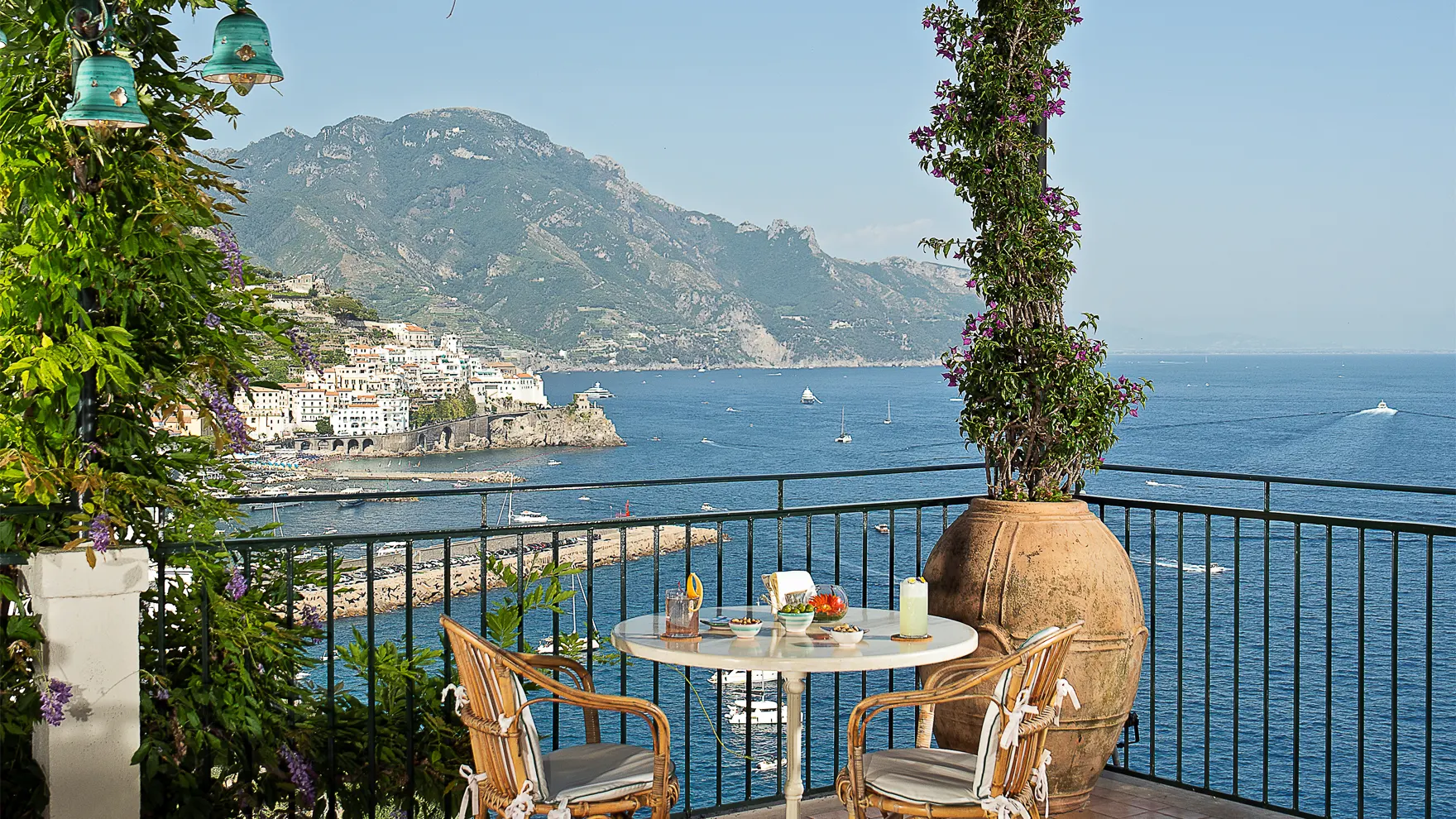
I was welcomed by Concetta, the Sales Executive, who guided me through the hotel’s spaces and into some of its rooms. But the first welcome, even before the human one, came from the lemon groves. Pergolas covered with greenery protect you from the sun, while the view opens wide over the coast. From above, the Amalfi Coast seems endless: cliffs dropping into blue water, villages suspended like painted memories, and a beauty so intense it stays with you long after you leave.
This is what American travelers dream of when they imagine Italy. Not only beauty, but beauty with a soul. Not only luxury, but luxury that has roots, character, and a sense of place.
Il San Pietro is quite literally carved into the cliff overlooking the Mediterranean. Its rooms and suites are designed as intimate retreats, with private terraces, hand-painted ceramic tiles, custom-made furniture, Italian textiles, and views that frame the sea like a living painting. Even the entry-level rooms, the smallest in the collection, have their own emotion: they are refined, bright, and deeply connected to the landscape. The larger rooms and suites become increasingly theatrical, some with vast private terraces, generous spaces, and that rare feeling of being completely alone with the horizon.
Then Concetta led me down, all the way to the private dock. We took another elevator, this one descending through the rock, and here the architecture becomes even more astonishing. You understand, step by step, that part of the hotel has been excavated directly into the cliff. It is not just built on the Amalfi Coast. It is built inside it.
At the bottom, the hotel reveals one of its most unforgettable treasures: a private beach club set in a natural cove with crystalline Mediterranean waters. The hotel notes that guests can reach it by an elevator cut into the cliff straight from the lobby, and once you arrive, the atmosphere changes again. The world above disappears. There is only the sea, the sun deck, the sound of water, and that very Italian art of doing nothing beautifully.
And yet Il San Pietro is not a place that invites only stillness. It also invites movement, energy, and a kind of glamorous wellness that feels completely natural here.
The gym is one of the most fascinating spaces I saw. Part of the fitness area is outside, protected by a pergola and shaded by lemon trees, with full views of the sea. The hotel describes its fitness center as a mix of indoor and outdoor equipment, with half of the gym set beneath a lemon orchard and surrounded by coastal views. Working out here in the cool hours of early morning, or at sunset when the light softens over the water, must be unforgettable. It leaves a mark — and not only the one caused by effort.
Then there is the tennis court. Reaching it by elevator already feels like a small adventure. Reaching it by the steep, seemingly endless stairs is another story entirely — let’s call it a warm-up for the brave. The court itself is spectacular, set between the rugged rock face and the pebble beach, with the sea as a constant presence. The hotel describes it as one of the most beautiful tennis courts in the world, and standing there, it is hard to disagree.
The rooms, the terraces, the beach, the gym, the tennis court: everything at Il San Pietro seems to follow the same philosophy. Nothing screams. Nothing needs to. The luxury here is confident, not loud. It is in the details, in the silence, in the way the hotel seems to protect you from the outside world while giving you the best possible view of it.
And then came the moment that turned the visit into a memory.
In the lobby bar, with its unmistakable Italian elegance, I was welcomed by the General Manager, Dr. Zana, who invited me to taste luxury through a Bellini cocktail. I sank into a comfortable sofa. A classical guitar began to play melodies that seemed to belong to the coast itself. In front of me, the view was breathtaking. My mind wandered through cinematic fragments, those images of Positano and the Amalfi Coast that American travelers have seen in films, photographs, old travel magazines, and dreams.

 Splendido private tours